What Misinformation Looks Like Across the Globe

By: Marie von Hafften | 01/30/2019
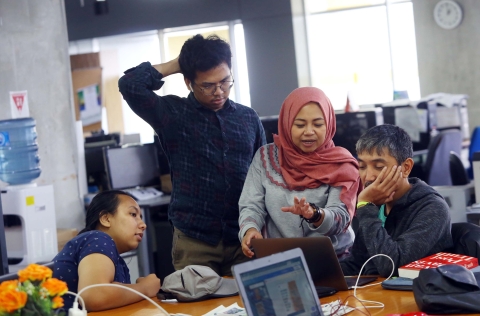
TruthBuzz Fellow Astudestra Ajengrastri (third from left) is partnering with Tempo to help spread facts online. Credit: Tempo

Misinformation can spread fear and erode trust, affecting voter behavior and even inciting violence. To help verified facts reach the widest possible audience, TruthBuzz Fellows with the International Center for Journalists (ICFJ) are working to bring new fact-checking formats and engagement strategies to newsrooms.

The five Fellows work in some of the world’s most populous nations. One is in Indonesia, where false information is going viral ahead of the 2019 presidential election. Another is studying misinformation in India, where mob violence killed at least two dozen people in 2018 after false child-kidnapping rumors spread on WhatsApp.

The TruthBuzz initiative, supported by Craig Newmark Philanthropies, allows Fellows to work full-time with newsrooms to find ways to counter misinformation for at least six months. Through a collaboration with First Draft News, Fellows receive training in fact-checking and verification. Watch the videos below to learn how the Fellows are countering misinformation in 2019.

Brazil

False information went viral during Brazil’s 2018 election. The messaging platform WhatsApp was a key culprit, according TruthBuzz Fellow Sérgio Spagnuolo. “Since WhatsApp is a closed communications app, it’s very hard to understand what is going on within it,” he said. Spagnuolo works with Aos Fatos and Folha de São Paulo to overcome this challenge and expand the reach of their fact-checking efforts. Find out more in this short video.

India

Shalini Joshi studies misinformation, particularly in India’s small towns and rural areas, as part of her TruthBuzz Fellowship. “Monitoring online content and putting out fact-checked information has been a huge challenge for India given the scale and sheer numbers of people consuming online content,” she said. Learn why insufficient fact-checking can be deadly in this short video.

Indonesia

TruthBuzz Fellow Astudestra Ajengrastri uses social media to help Indonesia’s voters find verified information ahead of the 2019 presidential election. “The campaign period has started, and supporters from both candidates are attacking each other with misinformation and disinformation,” she said. Discover how Ajengrastri is tackling the challenge with Tempo, one of Indonesia’s largest media houses, in this short video.

Nigeria

One of the biggest misinformation challenges in Nigeria is the use of closed message apps and social media channels to spread false and misleading photos and videos, according to TruthBuzz Fellow Hannah Ojo. “This misinformation distorts credibility in public debate,” she said. Ojo works with Africa Check and Daily Trust to spark social media engagement around fact-checking through mobile-friendly graphics and videos. Learn more in this short video.

United States

TruthBuzz Fellow Matt Riley makes fact-checking in the United States more accessible to help audiences sort fact from fiction. “Russian interference in the 2016 U.S. presidential election shows how countries and political parties can use fake social media accounts to influence voting behavior, and it is often incredibly difficult to tell these fake accounts apart from real ones,” he said. Explore how Riley collaborates with the News & Observer and PolitiFact to bring verified information to new audiences in this short video.

This story is cross-posted on the ICFJ TruthBuzz blog on Medium.

Country/Region

Latest News

Media Pioneer Patricia Mercado Sánchez Wins 2026 ICFJ News Innovation Award

The International Center for Journalists (ICFJ) today announced Patricia Mercado Sánchez, founder and CEO of Conexión Migrante, as the recipient of its 2026 ICFJ News Innovation Award. Mercado Sánchez leads a small team of journalists that has grown Conexión Migrante into a trusted, multi-platform lifeline for Latin American migrants in the U.S.

The European Journalism Centre Joins Plus Alliance as Constituent Member

The European Journalism Centre (EJC) is joining Code for Africa, ICFJ and PROTO as a constituent member of our expanding joint initiative, now known as the Plus alliance (formerly ICFJ+).

African Journalists Receive ICFJ-Wikimedia ‘Open the Knowledge’ Awards

Three journalists from Africa are being honored through the Open the Knowledge Journalism Awards, a story contest presented by the International Center for Journalists (ICFJ), in partnership with the Wikimedia Foundation, the nonprofit that operates Wikipedia.