Just months before the war, Naaman Ashtawy of Gaza was one of several newsroom leaders taking part in an ICFJ program on media sustainability.
Now, the ICFJ network member operates his photo agency from what has become one of the world’s deadliest conflict zones.
Photos shot by Naaman’s team at APA Images have been published in outlets ranging from CNN and Deutsche Welle to The Guardian, at a time when Israel has largely barred foreign media from Gaza. As Naaman told us recently: “Journalists in Gaza play a tremendous role in showing the world the horrors of this war, and they are paying a price.”
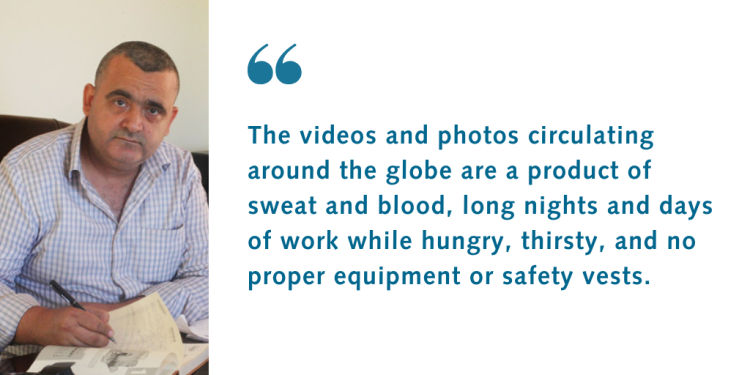
Earlier this year, Naaman was injured by shrapnel in his face, arm and leg during an Israeli bombing at Al Aqsa Hospital that also wounded two of his team members. Later, he and his colleagues fled the hospital as Israeli forces drew near.
“We are on another difficult journey to nowhere,” Naaman wrote to us at the time. “We’re still considering all options, while trying to keep our operations going as much as possible. Absolutely no place in Gaza is safe.”
Naaman’s situation is harrowing, and not unusual.
According to the Committee to Protect Journalists (CPJ), since the war began at least 128 journalists and media workers have been killed in Gaza, the West Bank, Israel and Lebanon, including some targeted by Israeli forces. The killings of journalists, who are civilians under the law, must stop, and Israel must investigate cases of journalists killed by their forces.
The overall death toll is, of course, vastly higher: More than 42,000 Palestinians and 1,200 Israelis have been killed since Oct. 7, 2023, when Hamas attacked Israel and seized about 250 hostages and Israel declared war in response. Tragically, the humanitarian situation in Gaza is catastrophic, more than 60 living hostages remain in Gaza, and the conflict is now intensifying in Lebanon as well.
Amid Israel’s restrictions on foreign media, Palestinian journalists are the eyes and ears of this devastating war. ICFJ, in a letter signed by more than 60 media and civil society organizations, called on Israeli authorities to immediately end these restrictions, which place “an impossible and unreasonable burden on local reporters to document a war through which they are living.”
I hope you will take a moment to read Naaman’s story, written by Sherry Ricchiardi, as well as those of other journalists. As the war approaches its 14th month, we can’t look away.