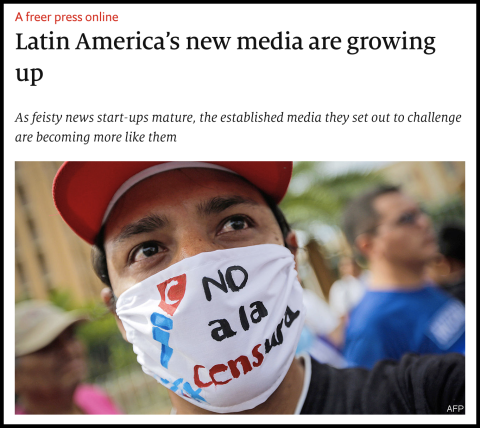
An article in The Economist spotlights how hard-hitting digital media startups are upending traditional news organizations in Latin America. It documents the trend with findings from SembraMedia, a nonprofit led by ICFJ Knight Fellow Janine Warner.
The article, “Latin America’s new media are growing up,” lays out how an increasing number of independent digital media startups in the region are calling out corruption - and how mainstream media are following their lead. The Economist emphasizes that these digital newcomers are the only independent news voice in authoritarian countries. In other Latin American countries, they are challenging entrenched media oligopolies.
The story draws upon SembraMedia’s Inflection Point, the first major study of business models and market conditions faced by Latin American digital media entrepreneurs. The report, funded by Omidyar Network, has now been cited more than 155 times by news outlets in 15 countries, according to Warner, who co-founded SembraMedia in 2015 with Mijal Iastrebner.
The Economist piece highlights digital media groups that were featured in the study, including ICFJ partner Connectas and Aristegui Noticias - led by former ICFJ Knight Award Winner Carmen Aristegui - for their role in the Panama Papers. It spotlights Chequeado for investigating corruption on both sides of the political spectrum, and Animal Político for reporting that influenced legislative change in Argentina. Both are winners of ICFJ’s TruthBuzz contest.
Warner, the executive director of SembraMedia, told The Economist that digital publishers can launch with “sweat equity alone.” And launching they are: SembraMedia has counted more than 770 digital media sites in 19 countries that “serve the public interest” and do not rely on a single corporation or party for revenue. Instead, new media organizations are diversifying their income through crowd-funding, grants and more.
These groups play a critical role in holding officials to account and providing independent coverage, even where the stakes are high. In Venezuela, for example, Efecto Cocuyo (Firefly Effect) - an ICFJ partner - has covered murder tolls and the black-market exchange rate.
Buoyed by their independent counterparts, traditional media are following suit and enhancing their own reporting. Chequeado’s fact-checking model has prompted newspapers in Brazil, for example, to create their own fact-checking teams. Others are reigning in self-censorship.
“The upstarts may be small,” The Economist writes, “but their impact is sizeable.”
Read The Economist article, and learn more about the Inflection Point study on IJNet.