Kemi Busari is a journalist and editor at DUBAWA, a fact-checking outlet focused on West Africa. He covers West Africa, disinformation and media literacy. He’s a 2024 winner of the Michael Elliott Award for Excellence in African Storytelling.
Busari reflects upon his experiences with ICFJ and why the organization’s work must continue. “For years, ICFJ has been at the forefront of supporting these journalists through funding, training, mentorship, fellowships, and institutional backing. Several of my colleagues have directly benefited from these programs,” he says.
In 2025, one of Busari’s mentees at DUBAWA won the Elliott Award with a story Busari edited. “This is a clear testament to the lasting impact of the experience ICFJ provided,” he says.
Originally, from Nigeria. Busari divides his time between Abuja and Maryland.
This interview has been edited slightly.
How have you been involved with ICFJ over the years?
My first real contact with ICFJ was about a decade ago when I subscribed to IJNet’s newsletter. The weekly updates offered valuable journalism resources that significantly enriched my knowledge early in my career. Then, in 2024, I received The Michael Elliott Award for Excellence in African Storytelling, through which ICFJ provided me the opportunity to work and learn at The Economist in London. This experience broadened my global perspective on journalism practice, which I implemented back home. In the same year, I served as a mentor for ICFJ’s Health Innovation Journalism Fellowship, guiding 12 journalists from different parts of the world. The opportunity allowed me to apply and further strengthen my mentorship skills.
What was the biggest outcome from participating in the programs?
The biggest outcome of my placement at The Economist was the opportunity to apply the lessons I learned to strengthen the DUBAWA newsroom back home. For instance, I adopted The Economist’s all-rounder approach to journalism, which trains staff to work across multiple editorial departments. Also, I took away some good lessons from their research team’s rigorous fact-checking system.
These insights, among others, contributed to building a stronger, more efficient DUBAWA team. A year later, one of my mentees from the team won the same Michael Elliott award with a story I mentored and edited him to produce. This is a clear testament to the lasting impact of the experience ICFJ provided.
Why is it so important right now to provide the kind of support to journalists that ICFJ does, especially in Africa?
Journalists in Africa operate within a landscape fraught with challenges. Poor remuneration, repressive media laws, physical and cyber attacks, and the undue influence of media owners are killing the genuine passion for public interest. For years, ICFJ has been at the forefront of supporting these journalists through funding, training, mentorship, fellowships, and institutional backing. Several of my colleagues have directly benefited from these programs. Indirectly, ICFJ’s online resources, such as tools, webinars, and trainings, have been valuable for the growth of many journalists, especially those who don't have formal journalism education in the continent. ICFJ must continue its credible journalism development work in Africa to help journalists continue their work for the social and political development of the continent.
What are you currently working on that you’re excited about?
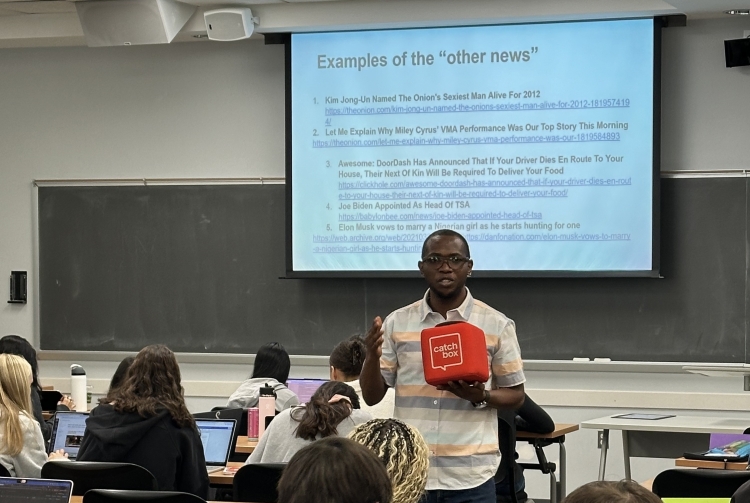
Apart from my editorial oversight work, I dedicate much time to training and mentoring the next generation of African journalists. Through the DUBAWA and several other projects, I have helped newsrooms set up fact-checking desks and train their fact-checkers.
I engage with student journalists through several initiatives, and I’ve midwifed the transition of hundreds of them into professional practice. I am committed to this, and I’m excited about it. Apart from core newsroom work, I am researching newsroom structure and practices, disinformation, and fact-checking.
Why did you choose to become a journalist?
It’s just natural for me. I developed the passion during my early primary education. My mum owned a shop, and our only gadget was a radio. When I listen to the radio, I mimic the people I hear and want to be like them. From there, I joined several press clubs and at the university, I started proper reporting as a student journalist. I just wanted to make positive changes in my society.
I want to use journalism to help people live a better life. One of my happiest days came in 2016 when my reporting helped a widow recover her six plots of land from notorious land grabbers in Lagos. My reporting revolutionized passport issuance in Nigeria to date. My documentation of extra-judicial killings during COVID-19 served as evidence in the court cases that followed. That is precisely what my journalism is about. Not accolades, but real impact.
What’s one piece of advice you’d give to an aspiring journalist?
It appears many entered or are doing journalism for the wrong reasons. Some want the fame, the awards, the credit, the money, and even some see it as a stepping stone to other “lucrative” opportunities. That’s a disturbing trend. My advice to aspiring journalists is to define their goals along with the public interest, strive for excellence in their work and every other thing they seek shall follow. Journalism is not self-serving. It must be done in the public interest.
*ICFJ’s Michael Elliott Award is celebrating its ten-year anniversary. You learn more about the program here, apply here and make a donation to support the program here.