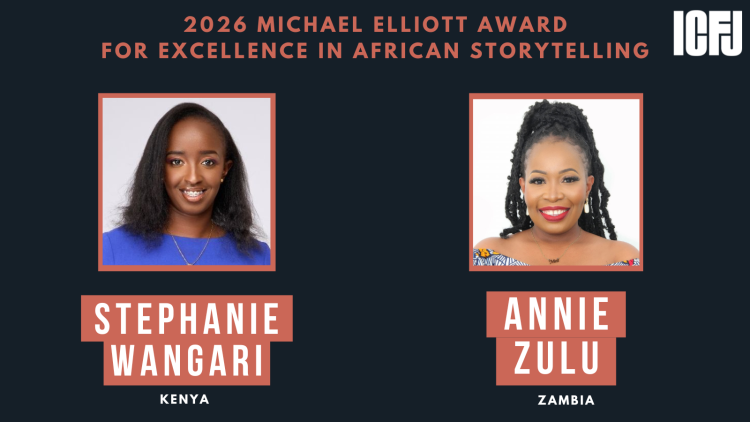
Stephanie Wangari of Kenya and Annie Zulu of Zambia are the 2026 winners of the Michael Elliott Award for Excellence in African Storytelling for their reporting that captures both the promise and the peril facing African communities today.
In her article for Rest of World, “Malawi’s new farmhand: AI that speaks the local language,” Wangari reported on how farmers in Malawi are using an AI app in their own language to achieve better farming outcomes.
Zulu’s piece in Viewfinder, “Sold for labour: The untold story of Zambian housekeepers trapped in Pakistan,” uncovered a cross-border human trafficking operation, revealing how Zambian women moving to Pakistan in search of a better life are often being trafficked or placed into servitude.
The Michael Elliott Award aims to advance the careers of emerging journalists in Africa who work to strengthen people’s voices and improve their well-being. The award is given out by the International Center for Journalists (ICFJ), in partnership with the ONE Campaign and the Elliott family. In addition to a cash prize, Wangari and Zulu will participate in a specialized professional development program at the London headquarters of The Economist, a generous long-time partner of the award.
The Elliott Award was established in honor of former ICFJ board director Michael Elliott, who served as a top editor at The Economist, Newsweek and Time before becoming CEO of ONE.
“This year marks the tenth anniversary of the Michael Elliott Award, and I am delighted to congratulate our newest winners. Stephanie Wangari and Annie Zulu’s brave and original work exemplifies the spirit and the range of the award,” said Emma Oxford, Michael Elliott’s widow.“I am tremendously grateful to our partners and donors for the continuing success of the program. And warm thanks to my fellow judges, especially Lionel Barber for his astute chairing of the selection committee.”
Wangari is a freelance technology journalist based in Nairobi, Kenya. “What struck me most was that farmers who once waited months for extension services [farming advice] could now access timely guidance when their crops needed it most,” she said.
“In a context where delays could mean the difference between a good harvest and loss, especially amid increasingly unpredictable weather driven by climate change, this shift felt urgent,” she added. “For the first time, innovation spoke to these farmers in their own language, in their own context, bridging a gap that had long left many behind.”
“I would like to extend my sincere thanks to my editors at Rest of World: Gayathri Vaidyanathan, Eric Bellman, Rina Chandran and Christine Glancey as well as visuals editor Munira Mutaher, photographer Thoko Chikondi, and translator Yamikani Makanga for their support and collaboration in bringing this story to life,” Wangari said.
Zulu is a freelance investigative journalist based in Lusaka, Zambia, who covers a range of topics including gender, human rights and climate change. “This story exposes a disturbing and underreported trafficking route, where vulnerable Zambian women are lured with promises of work in Pakistan, only to face exploitation, abuse, and, in some cases, forced survival in extreme conditions,” she said. “It matters because it reveals how systemic gaps, both at home and abroad, leave these women unprotected while traffickers continue to operate with little accountability.”
“I’m deeply grateful to the survivors who bravely shared their experiences, often at great personal risk, as well as to my editor, Daneel Knoetze, who supported me throughout the reporting process on this project,” she said.
“I salute two outstanding winners among a strong group of entries across Africa in this year’s Michael Elliott award,” said Selection Committee Chair Lionel Barber “The judges were impressed by the winners’ deep and original reporting and the overall impact of their journalism.”
This year’s award judges were:
Adekunle Adebajo, Editor of the African Academy for Open Source Investigations (AAOSI) at Code for Africa, and 2023 Elliott Award Winner
Lionel Barber, Chair, Former Editor of the Financial Times and Author of “Gambling Man”
Matthew Bishop, Nonresident Senior Fellow, Global Economy and Development, Brookings Institution
Roxana Elliott, Senior Director, Content, DigitalOcean
Catherine Gicheru, Former ICFJ Knight Fellow and Director of the Africa Women Journalism Project
Abubakar Ibrahim, Daily Trust Editorial Board Member and 2018 Elliott Award Winner
Rik Kirkland, Chair, Douglas Knowledge Partners; Senior Advisor, McKinsey and Company; and ICFJ Board Director
Adrian Lovett, Executive Director, ONE
Sharon Moshavi, President, ICFJ
Emma Oxford, Author of “At Least We Lived”
Lena Schipper, Africa Editor, The Economist
Dorcas Wangira, Health Correspondent, BBC Africa and 2019 Elliott Award Winner
About the Michael Elliott Award
Michael Elliott, a passionate writer and editor with a gift for unraveling complex issues, shone a light on global development issues and the people at their center. A longtime board member of ICFJ, Elliott championed great journalism as a tool for empowerment. As ONE’s CEO, he lobbied to improve the lives of all Africans. Shortly before his untimely death in 2016, Elliott spoke of his dream to establish an award that would bring together his belief in great journalism with his commitment to progress in Africa.
Previous Elliott Award winners include Mercy Juma, Linda Ngari, and Dorcas Wangira of Kenya; Bernadette Vivuya of the Democratic Republic of the Congo; Khalid Bencherif of Morocco; Nalova Akua of Cameroon; Godwin Asediba of Ghana; Farai Shawn Matiashe of Zimbabwe; and Silas Jonathan, Abubakar Ibrahim, Kiki Mordi, Zainab Bala, Kemi Busari, and Adekunle Adebajo of Nigeria. These talented journalists have uncovered child labor in mines, exposed sexual harassment in universities, documented Russian disinformation efforts, and more.