
The online format makes courses accessible to many more journalists, accommodating both widespread locations and typically long work hours, said Xavier Serbia, instructor of the Spanish-language course.
“Schedules are very flexible,” Serbia said. “If he or she wants, a journalist can start studying after midnight, after finishing work. It’s what journalists who want to remain in the market must do.”
These journalists said the courses familiarized them with difficult financial topics. They spoke of learning the importance of balanced viewpoints, informational graphics, and particularly the human angle. Many also expressed the desire to continue reporting about personal finance.
Over the past three years, ICFJ has trained at least 100 journalists in personal finance programs throughout the United States. The programs, both online and in classrooms, are sponsored by the McGraw-Hill Companies.
“As a result of these courses, these journalists are helping their communities strengthen and be better informed,” said ICFJ President Joyce Barnathan.
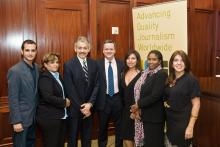
The journalists in the two recent courses published their articles in the media outlets where they write. Also, six of them visited New York City, where they met with business leaders and journalists.
Three of the six were honored for their articles. First place went to Elizabeth Ostos, at Mercado de Dinero, a monthly newspaper published in Miami. Her article, “Credit Consolidation in the Age of an Indebted Country,” told the story of a Latino family struggling because of credit card debt and hefty mortgage. Second place honors went to Carlos Rajo of Telemundo Los Angeles for his article, “A House of Their Own: Is the American Dream Too Expensive?” Rajo wrote about the particular hurdles to home ownership that Hispanics face. Third place went to Ann Marie Adams of The Hartford Guardian. Her article, “Losing Ground: Foreclosure Rate Higher Among Minority Homeowners,” detailed foreclosures among minority groups in Connecticut.
Ostos, who has taken several online courses, sees them as the way of the future. Familiarity with multimedia is essential, she said, “and journalists are truly able to work during the day and then study at night or early in the morning. It’s an advantage.”
This course has made her a better journalist, Ostos said: “I’m better informed today about the topics I write about. I have more information to interpret the numbers, and I’ve greater access to sources. My horizons have definitely been expanded.”