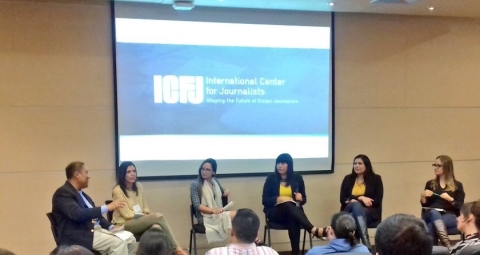
Increasingly restrictive media regulations and the “law of terror and violence” are the greatest threats to freedom of expression in Latin America, members of a panel of women journalists said at a recent Connectas-ICFJ conference in Medellín, Colombia.
In Venezuela, most of the traditional media are now completely controlled by the government, said Ronna Rísquez, an investigative reporter for RunRunes, a leading Venezuelan online news organization. “Digital news media are the only ones reporting the news that the government wants to keep hidden,” she added.
The situation is similar in Ecuador, where the government has an open battle with independent news organizations. A recent bill submitted to Ecuador's Congress would criminalize so-called “hate speech and discrimination” committed on social networks and the internet. Such laws can be so ambiguous that governments can use them to prosecute journalists for virtually any speech authorities choose.
“This is one of the legacies left by former President Rafael Correa,” said Daniela Aguilar of La Historia, an independent online news organization. Correa was succeeded this year by Lenín Moreno, who is from Correa’s party.
Repressive governments also use financial methods – or “squeezing your pocket” – to control the media, said Bolivian freelance reporter Nathalie Iriarte.
“Seventy percent of the media in Bolivia is financed by the government,” she said. “The president says that the media not receiving funds from the government are the country’s enemies.”
During the discussion hosted by EAFIT University, several panelists agreed that what they called the “law of terror and violence” is one of the greater threats to press freedom in Latin America. Priscilla Hernández of Mexico’s W Radio highlighted that this wave of violence has paralyzed the media. “News organizations tell you that they do not have the infrastructure or a way to protect you if something happens,” she said.
The panel kicked off the Investigatón organized by Connectas and the International Center for Journalists, attended by more than 50 journalists from 10 Latin American countries. During the four-day event, participants worked on in-depth reporting projects with the help of experienced mentors.
In partnership with Connectas, a Colombia-based organization promoting cross-border news reporting, ICFJ is implementing the Investigative Reporting Initiative for the Americas. The program is creating a cadre of investigative reporters who use digital tools to cover issues such as corruption, drug and human trafficking, gang violence and environmental degradation. The program also matches reporters to work across borders on multinational stories in Latin America, a region where self-censorship and threats against journalists are common.
During the last four years, the program has produced more than 100 in-depth stories exposing nearly US$3.8 billion of mismanagement of public funds in Latin America.