
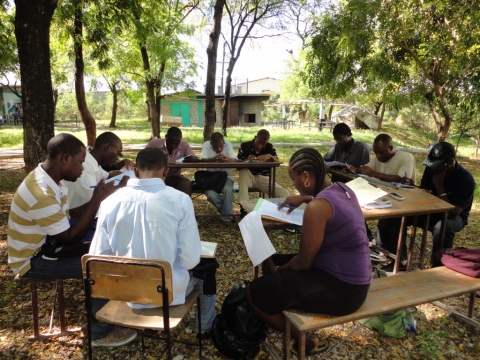
We no longer meet in a tent but under the shade on the school grounds.
Several weeks into an investigative training program for Haitian journalists who lost their jobs after the January 2010 earthquake, a second group of journalists asked to join.
Our first session was held in a tent on the grounds of a state school in Cite Soleil, which for years was referred to as the poorest slum in the Western hemisphere. With a million or so people still living in camps throughout the capital since last year’s earthquake, I’m not sure that label still fits. But there’s no argument that the population is poor. And homeless.
This particular group, the Association of Young Journalists Working for Another Haiti (AJJCAH), was formed after the members graduated from a journalism ‘trade’ school. Only one member is currently employed as a journalist.
I wasn’t sure what to expect. As I do before every training, I asked the journalists to fill out a form that would help me see how much they understood about the differences between “conventional” and “investigative” journalism. On the whole, AJJCAH scored higher than a group of employed journalists from one of Haiti’s top radio stations.
The AJJCAH journalists are highly motivated. It’s not just that they have more time on their hands than employed journalists. They are hungry for knowledge and have officially blessed me for a long life so that they can have many more years of training. I haven’t the heart to tell them that the Fellowship only lasts a year!
Several of them are already working on an investigation into “journalism” trade schools. They’ve created a questionnaire for the journalism school owners that they will compare with the responses from the schools’ graduates. This will help them evaluate how effective the school training is and what kind of education working journalists have. A second group is looking at the services provided by the non-governmental agencies in one of the tent camps.
A third group has already turned its lack of success into a story. Humiliated at every turn by the people the journalists tried to interview for an investigation on the women’s prison, the director of the association wrote an op-ed piece denouncing the lack of respect journalists receive:
“Overall, we Haitian journalists want our opponents to know that we have a right to information, that we enjoy the rights guaranteed by Article 19 of the 1948 Universal Declaration of Human Rights and Article 19 of the 1996 International Covenant on Civil and Political Rights, signed and ratified by 154 states. The authorities may not harass or intimidate or obstruct Haitian journalists in any manner whatsoever, any more than they can censor their words or writings, or attempt to influence them by any means.”
If I was a media owner, I’d be lucky to have an ACCJAH member as part of my staff.